

Artificial intelligence is transforming the legal profession. But working effectively with AI requires skill. The prompting, the instructions you give to AI, largely determines the quality of results you get. Specialized legal AI systems, combined with targeted prompt engineering, can significantly streamline your legal work.
Drawing on hundreds of hours of practical experience with numerous legal AI systems, this article shows you which prompting techniques deliver the best results, how to avoid common pitfalls, and how to make your legal work sustainably more efficient.
What is Legal Prompting?
Legal prompting is the formulated legal task you present to AI. The more precisely you write your prompt, the better the AI's results will be.
A well-crafted prompt works like a well-structured brief: it guides the AI's "thinking" in the desired direction, defines the legal context, and ensures all relevant aspects are considered. The crucial difference from human conversation partners is that AI systems rely more heavily on the quality and precision of your instructions.
With developing effective prompts, so called prompt engineering, we consider structure, language, and information content to achieve optimal results.
Essential components of a prompt
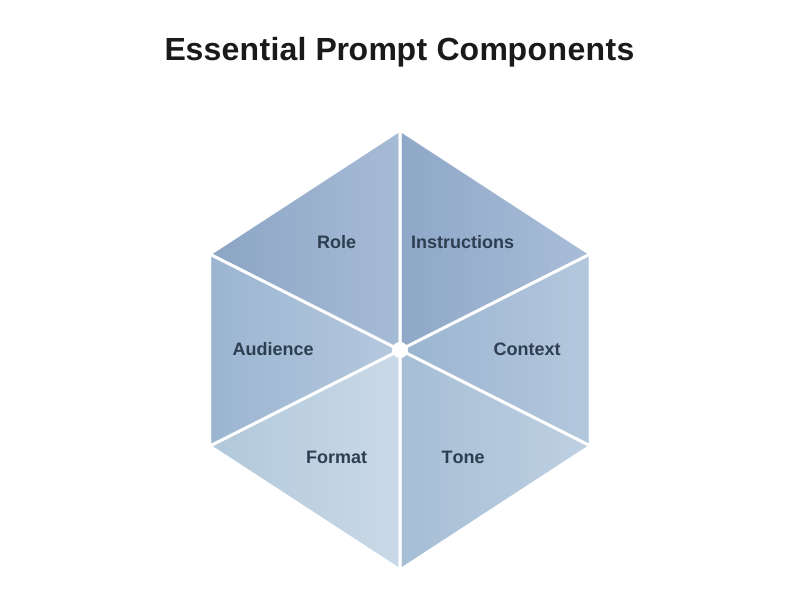
To develop a legal prompt that delivers high-quality results, it should follow a clear architecture. The following six components have proven effective in practice and serve as guidelines for building your prompt systematically.
1. Instructions – The core of your prompt
The instruction defines what task the AI should perform. Legal prompts differ fundamentally from everyday AI queries because the legal context should be described as precisely as possible. For example: "Analyze the wrongful termination lawsuit against an operational dismissal and evaluate the likelihood of success considering current Federal Labor Court decisions."
2. Context – Defining the legal context
Here you add all relevant background information that should be considered, such as statutory texts, contract documents, facts, or specific judgments. With this information, you define the legal framework within which the AI should work.
3. Role – Defining legal expertise
The formulation "Act as an experienced tax law specialist with 15 years of practice experience" ensures the AI formulates its answers at a correspondingly high level of expertise. You can also adapt the role situationally: "Take the perspective of a critical judge" leads to different analyses than "Argue from the opposing counsel's perspective."
4. Audience – Who are you writing for?
Describing your target audience influences the language style and technical depth of the AI response. Particularly effective is: "Assume I'm a client without legal background, but smart enough to understand complex relationships when well explained."
5. Format – Defining structure and scope
Concrete format specifications like "Structure your answer in three sections with a maximum of 200 words each" or "Create a table with columns for legal issue, legal basis, and solution approach" help the AI present structured and clear answers.
6. Tone and style – The linguistic level
The choice of tone influences not only readability but also persuasiveness. "Formulate objectively and neutrally for a statement" leads to different results than "Argue convincingly and assertively for a negotiation."
The 10 Most Important Prompting Strategies for Legal Professionals
Beyond the building blocks above that determine your prompt's structure, there are fundamental tips for optimally formulating legal prompts. Here are the ten most important prompting tips for legal professionals.
1. Precision beats politeness
Formulate concisely and precisely. You can skip vague and overly polite forms of address. Phrases like "Could you perhaps..." dilute your instruction and can lead to unclear results. Instead, be direct: "Analyze the liability clause in § 12 of the attached contract for its validity under German standard terms law. Consider current Federal Court of Justice decisions on liability exclusions in B2B contexts."
2. Harness the power of positive formulations
AI systems, like humans, process positive instructions more efficiently than negative ones. Instead of "Don't ignore the current legislative changes," formulate: "Consider the current legislative changes since January 2024." The positive formulation guides the AI more directly to the desired information.
3. Encourage step-by-step thinking
The instruction "Proceed step by step and take time for each analysis step" activates a more structured thinking process in AI systems. It "forces" the model to think through intermediate steps rather than jumping directly to conclusions. In legal contexts, this means systematic examination of facts, legal situation, and evaluation.
4. Require source citations as quality assurance
The explicit instruction "For every legal statement, cite the specific legal basis, relevant judgment, or corresponding literature reference" improves not only verifiability but also the quality of AI responses. You can also specify formatting requirements, such as "Structure your answer so that each legal statement is followed by a source citation."
5. Use uncertainty productively
The instruction "If you're not completely certain about a legal statement, say so explicitly and explain what additional information would be needed for a reliable assessment" transforms the AI weakness of hallucinations into a strength. You receive honest communication about knowledge boundaries and indications of necessary additional research.
6. Structure through deliberate formatting
Use punctuation, line breaks, and structural elements as active control instruments. A well-structured prompt, like the following, leads to better structured and usable answers:
TASK: Evaluation of success prospects for a wrongful termination lawsuit

FACTS: [Detailed description]

LEGAL EXAMINATION POINTS:
1. Admissibility:
[List of requirements]
2. Merits:
[List of requirements]

FORMAT: For each examination point, a detailed legal analysis in at least three sentences.
7. Few-shot prompting: Leading with examples
When you provide one to three concrete examples of the desired format, quality improves significantly. For contract clause analyses, this could look like:
Analyze the contract clause according to the following pattern:
CLAUSE: [Wording]
REQUIREMENT: [Requirement]
ASSESSMENT: [Invalid/Questionable/Acceptable]
JUSTIFICATION: [2-3 sentences]
8. Legal terminology as a precision instrument
Deliberately use exact legal terms: "Examine the lawfulness of personal data processing under Art. 6 Para. 1 GDPR, particularly with regard to legitimate interests under lit. f" is more precise than "Check if the data use is legal." Technical language helps specialized legal AI systems identify the relevant areas of law and respond with precise formulations.
9. Perspective shifts as an analysis tool
"First analyze the case from the plaintiff's perspective, then from the defendant's perspective, and subsequently evaluate from a neutral judge's perspective the success prospects of both sides" leads to more balanced and thoughtful analyses. This multi-perspective analysis helps identify weaknesses in your own argumentation.
10. Iterative refinement as a success strategy
Start with simpler prompts and refine them based on results. Begin with a basic query, analyze the answer, and then formulate a refined follow-up question: "Your analysis on point 2 was helpful. Now deepen the argumentation on social selection criteria and consider Federal Labor Court decisions on the requirements in § 1 Para. 3 Protection Against Dismissal Act."

Multi-step prompting for complex tasks
When facing complex legal tasks that should be broken down into structured, sequential steps, you'll achieve better and more transparent results with multi-step prompts. There are various methods you can choose based on your needs.
Multi-step prompting: The chain of individual tasks
Break down a complex analysis into logically sequential individual steps and instruct the AI step by step. Here's a practical example for contract analysis:
Step 1: "Read through the following list of examination points and extract all relevant clauses from the attached contract document for each point."
Step 2: "Go through the examination points one by one and check whether the extracted clause meets the legal requirements of the examination point."
Step 3: "Create a table presenting the examination results. The table should contain the following columns: Examination Point | Clause | Assessment"
The advantage: The result of each step can be individually reviewed and corrected by you before the next step builds on that result.
Chain-of-thought: The reasoned thought process
When you need full transparency about the AI's result, you can instruct it to disclose its complete solution-finding process. An example of such a prompt would be:
Examine the content of the attached General Terms and Conditions systematically using the following schema:
Clause prohibitions without possibility of evaluation (§ 309 German Civil Code)Clause prohibitions with possibility of evaluation (§ 308 German Civil Code)Transparency requirement (§ 307 I 2 German Civil Code)General clause (§ 307 I 1 German Civil Code)
Add a detailed explanation for each examination point with reference to the cited norms.
Reverse prompting: From goal to path
You know exactly what the final result should look like, but lack the corresponding prompt? With reverse prompting, you flip the classic logic of prompting: Instead of giving the AI an instruction and receiving a result (Prompt → Output), it works in reverse (Output → Prompt). You provide a desired result, for example, a text or clause, and have the AI generate the prompt that would most likely lead to exactly this result. This is particularly useful when you want to optimize your own prompts and reuse them for similar tasks.
An example could look like this:
This is a legal clause for GDPR consent: [Example text]. Formulate the prompt I would need to enter for you to produce exactly this result.
Your path to prompting expertise
The legal industry is digitalizing rapidly, and AI deployment is becoming an integral part of legal work in companies, law firms, and government agencies. Against this backdrop, legal prompting is developing into an indispensable core competency for modern legal professionals – a skill that not only enables efficiency gains but also sustainably improves work quality.
The decisive success factor lies in combining legal expertise with AI power: Those who learn to optimally integrate their professional knowledge through skilled prompting into collaboration with specialized legal AI can fully exploit the potential of this technology and their work.

Nils Feuerhelm